Ford’s 5 Dollar Deal
1. Introduction
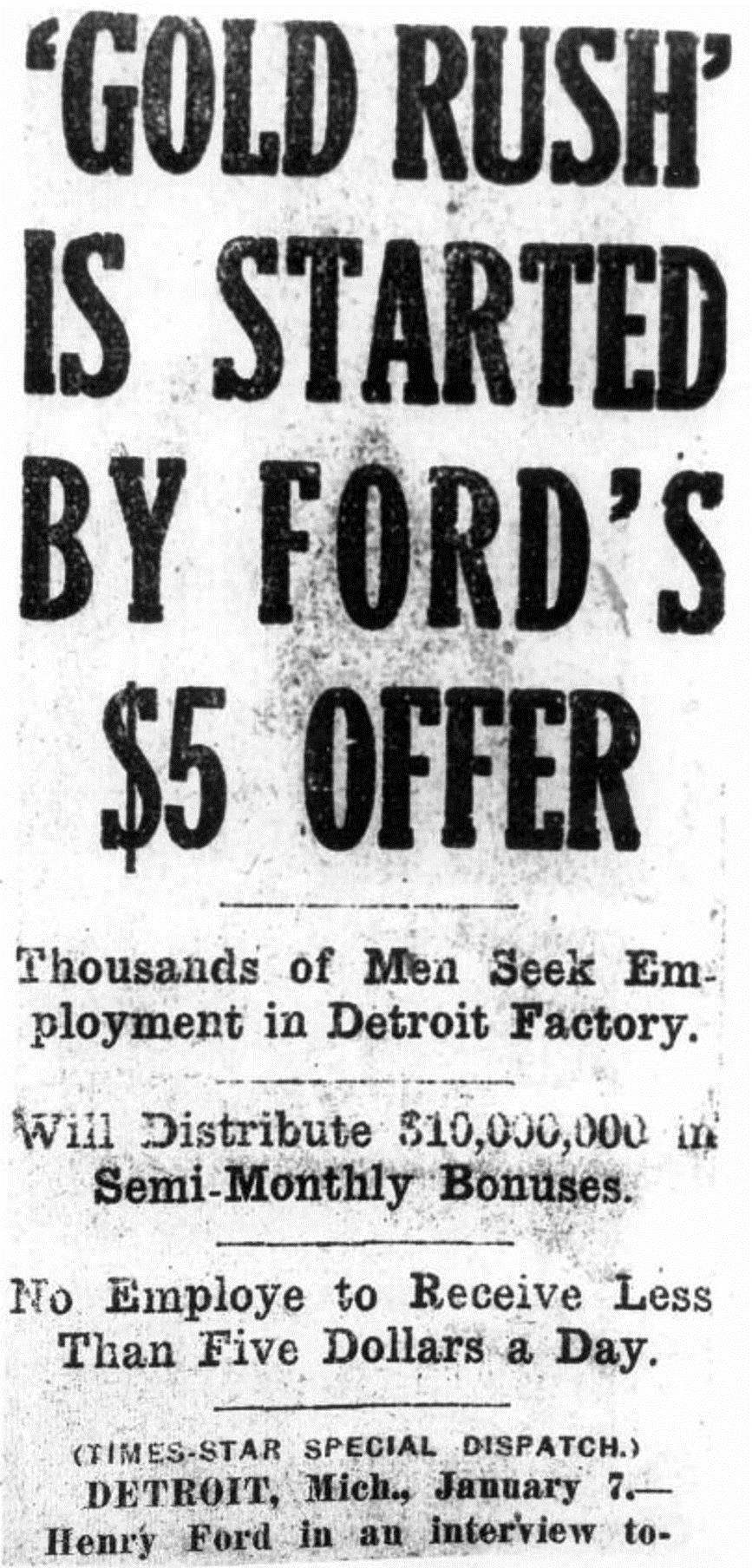
On 5 January 1914, Ford Motor Company introduced a wage of \$5 per day for an eight-hour shift, more than double the previous rate of $2.34 for a nine-hour day. Before the wage increase, the company had a 380% labour turnover rate, and workers were dissatisfied with the monotonous demands of the moving assembly line1, 2. After the new wage, production rose from 202,667 cars in 1913 to 308,162 in 1914 and 501,462 in 1915, while thousands of job seekers went to Ford’s employment windows3, 4. The case is a useful application of the efficiency wage model: above-market wages can raise effort, reduce turnover and improve productivity.
For more on the Ford’s 5 dollar wage, see Did Henry Ford Pay Efficiency Wages?5.
2. The Efficiency Wage Model:
Efficiency wage theory challenges the classical view that wages merely clear the labour market. Instead, it says that a higher wage can increase worker effort and reduce shirking, which raises productivity. Two equations capture the mechanism:
A. The Profit Function and Effective Labour
The representative firm’s profit function is given by:
\pi = F(eL) - wL,
where:
- F(eL) denotes production output as a function of “effective labour” (the product of the number of workers L and the effort e they exert),
- w is the wage rate, and
- e is the worker’s effort, which increases with the wage: e = e(w) with e'(w) > 0.
Intuition:
Even if assembly line work remains as relentless as before, a higher wage w can raise worker effort, e(w), and make each worker more productive. For Ford, the promise of \$5 per day helped reduce resistance to the new assembly line discipline.
B. Optimal Wage Determination
When a firm chooses both the wage w and the number of workers L, two first‑order conditions arise:
Marginal Product Condition:
F'(e(w)L) = \frac{w}{e(w)}
This condition ensures that the marginal product of effective labour equals its cost.
Efficiency Wage (Elasticity) Condition:
\frac{w \, e'(w)}{e(w)} = 1. \tag{1}
Interpretation:
This condition states that the wage should be set so that the elasticity of worker effort with respect to the wage is unity. In other words, a marginal increase in the wage leads to an exactly proportional increase in effort. Ford’s jump from \$2.34 to \$5 can be read as an attempt to reach, or exceed, the threshold where the extra wage cost is offset by higher worker productivity.
3. Historical Statistics and Their Connection to the Model
The statistics can be linked directly to the model.
A. Pre-Policy Conditions: Low Wages, High Turnover, and Low Effort
- High Turnover:
- Statistic: In late 1913, Ford Motor Company experienced a turnover rate of 380%6.
- Model Connection: A low wage implies low worker effort e(w), as suggested by the monotonic relationship e'(w) > 0. With insufficient compensation, workers had little incentive to commit to the strenuous work, leading to high turnover. The effective cost per unit of labour, \frac{w}{e(w)}, was high because productivity suffered from low effort and frequent rehiring costs.
- Statistic: In late 1913, Ford Motor Company experienced a turnover rate of 380%6.
- Assembly Line Challenges:
- Statistic: The moving assembly line reduced chassis assembly time from over 12 hours to 2 hours and 40 minutes, but also made work more monotonous7, 8.
- Model Connection: The rapid pace required workers to exert high effort. Under low wages, the induced effort e(w) was inadequate, contributing to dissatisfaction and turnover. The assembly line’s efficiency potential was not fully realised until worker incentives were realigned with the higher wage.
- Statistic: The moving assembly line reduced chassis assembly time from over 12 hours to 2 hours and 40 minutes, but also made work more monotonous7, 8.
B. Post-Policy Outcomes: High Wages, Elevated Effort, and Improved Productivity
- Dramatic Increase in Production Output:
- Statistics: Production output jumped from 202,667 cars in 1913 to 308,162 in 1914, and then to 501,462 in 19159.
- Model Connection: According to the production function F(eL), an increase in worker effort e(w) raises output. By setting w high enough to satisfy the elasticity condition (Equation 1), Ford increased each worker’s effective labour, leading to higher overall production.
- Statistics: Production output jumped from 202,667 cars in 1913 to 308,162 in 1914, and then to 501,462 in 19159.
- Surge in Job Applications and Worker Retention:
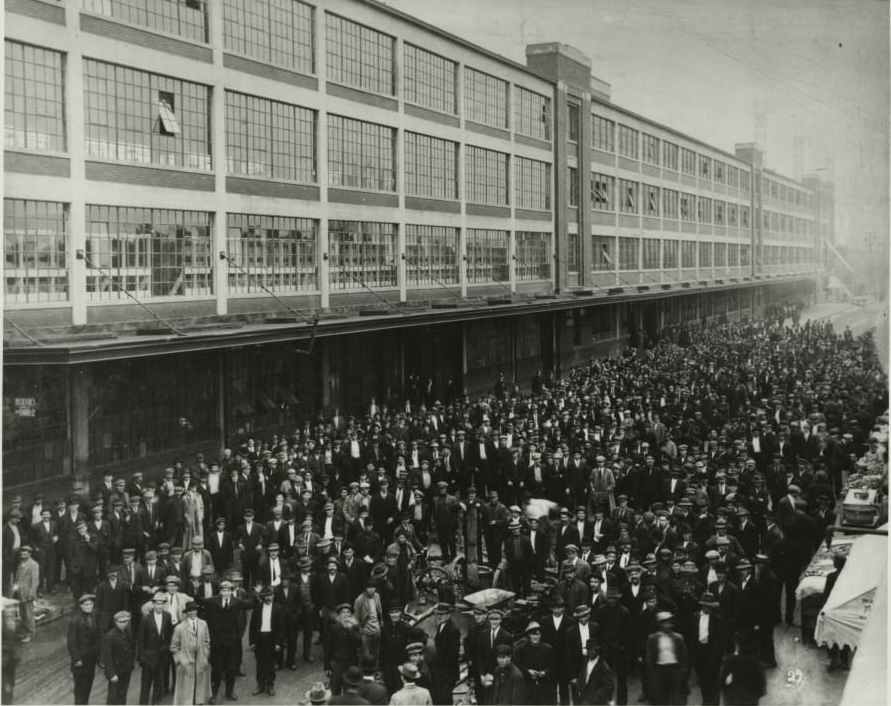
- Statistics: The day after the wage announcement, approximately 10,000 job seekers gathered at Ford’s employment window, with some arriving as early as 3 a.m.10. Post-policy, the turnover issue effectively disappeared11.
- Model Connection: A wage above the prevailing market rate (w > w_a) draws a larger pool of applicants. In an extended efficiency wage model where worker effort also depends on the prevailing wage w_a and the unemployment rate u (i.e., e = e(w, w_a, u)), a high wage increases e(w) and helps retain workers who can perform under strict conditions. This screening mechanism improves productivity and reduces turnover.
- Statistics: The day after the wage announcement, approximately 10,000 job seekers gathered at Ford’s employment window, with some arriving as early as 3 a.m.10. Post-policy, the turnover issue effectively disappeared11.
- Economic and Social Impact:
- Statistic: Ford’s wage increase is credited with boosting thousands of workers into the middle class, enabling them to afford the very Model Ts they helped produce12, 13.
- Model Connection: Beyond productivity, higher wages improve worker welfare. In efficiency wage models, the wage premium not only induces higher effort but can also increase worker attachment and improve labour-force quality, which benefits both the firm and its workers.
- Statistic: Ford’s wage increase is credited with boosting thousands of workers into the middle class, enabling them to afford the very Model Ts they helped produce12, 13.
4. Intuitive Synthesis: Why Ford’s Policy “Worked”
Ford’s policy can be read through the model as follows:
- Before the Wage Increase:
- Low w led to low e(w): Workers were not sufficiently motivated by the low wages to exert the effort required by the new assembly line methods. This produced a turnover rate of 380%14, which raised the effective cost of labour through recruitment and training costs.
- After the Wage Increase:
- High w induced high e(w): By raising the wage to \$5 per day, Ford moved towards the condition where the elasticity of effort with respect to the wage (\frac{w \, e'(w)}{e(w)} = 1) was met. The higher wage increased worker effort, reduced turnover and increased production output15, 16.
- Worker Attraction and Screening: The premium wage attracted many applicants and allowed Ford to screen for workers willing to accept the demanding conditions, producing a more productive and committed workforce.
- Overall Economic Impact:
- Improved Productivity and Social Mobility: The increased output, combined with improved worker retention, lowered the effective cost per unit of effective labour \left(\frac{w}{e(w)}\right). It also moved many workers into the middle class, as they could now afford the products they helped manufacture17, 18.
5. Conclusion
Henry Ford’s \$5 wage policy illustrates efficiency wage theory in practice. The effects on production output, worker retention and job applications can be linked to the key model equations:
- The profit function \pi = F(eL) - wL shows why effective labour eL is central for output.
- The condition \frac{w \, e'(w)}{e(w)} = 1 says that any increase in wages is exactly matched by an increase in worker effort, lowering the cost per effective unit of labour.
By setting a wage substantially above the prevailing rate, Ford improved retention, raised production and reshaped industrial relations. These outcomes are consistent with the efficiency wage model and with the historical evidence19, 20, 21, 22.
References
The Henry Ford. “Expert Sets on the Ford Motor Company Archives.” Link↩︎
Kellogg School of Management, Northwestern University. “Henry Ford’s Five Dollar Day.” Link↩︎
The Henry Ford. “Frequently Asked Questions on Ford Production.” Link↩︎
The Henry Ford. “Expert Sets on the Ford Motor Company Archives.” Link↩︎
The Henry Ford. “Expert Sets on the Ford Motor Company Archives.” Link↩︎
The Henry Ford. “Frequently Asked Questions on Ford Production.” Link↩︎
Kellogg School of Management, Northwestern University. “Henry Ford’s Five Dollar Day.” Link↩︎
The Henry Ford. “Expert Sets on the Ford Motor Company Archives.” Link↩︎
Kellogg School of Management, Northwestern University. “Henry Ford’s Five Dollar Day.” Link↩︎
The Henry Ford. “Expert Sets on the Ford Motor Company Archives.” Link↩︎
The Henry Ford. “Expert Sets on the Ford Motor Company Archives.” Link↩︎
The Henry Ford. “Frequently Asked Questions on Ford Production.” Link↩︎
Kellogg School of Management, Northwestern University. “Henry Ford’s Five Dollar Day.” Link↩︎
Kellogg School of Management, Northwestern University. “Henry Ford’s Five Dollar Day.” Link↩︎
The Henry Ford. “Expert Sets on the Ford Motor Company Archives.” Link↩︎
Kellogg School of Management, Northwestern University. “Henry Ford’s Five Dollar Day.” Link↩︎
The Henry Ford. “Expert Sets on the Ford Motor Company Archives.” Link↩︎
The Henry Ford. “Frequently Asked Questions on Ford Production.” Link↩︎