
The paper starts from a simple problem. Central banks can write clearer messages, but the public first has to notice them. Social media provides a setting where the attention margin can be observed directly through visible engagement.
The paper studies official Bank of England tweets, not all tweets about the Bank. It measures engagement as likes, retweets, replies, and quote tweets. The main estimates are tweet-level associations, not causal effects, because the Bank chooses formats and timing endogenously.
The evidence is practically useful. Visual formats and policy-relevant timing are associated with much higher engagement. Reply tweets receive far less visible engagement, showing that two communication goals can conflict: dialogue may be valuable, but it does not necessarily maximise reach.
Photo tweets and video tweets receive much higher engagement than otherwise similar tweets.
Research question
Which official central-bank messages receive visible public engagement on social media?
Why it matters
Central-bank communication with the public cannot affect beliefs if it never crosses the attention threshold. The paper therefore studies the pre-comprehension stage of communication: attention and interaction.
Data and method
Data
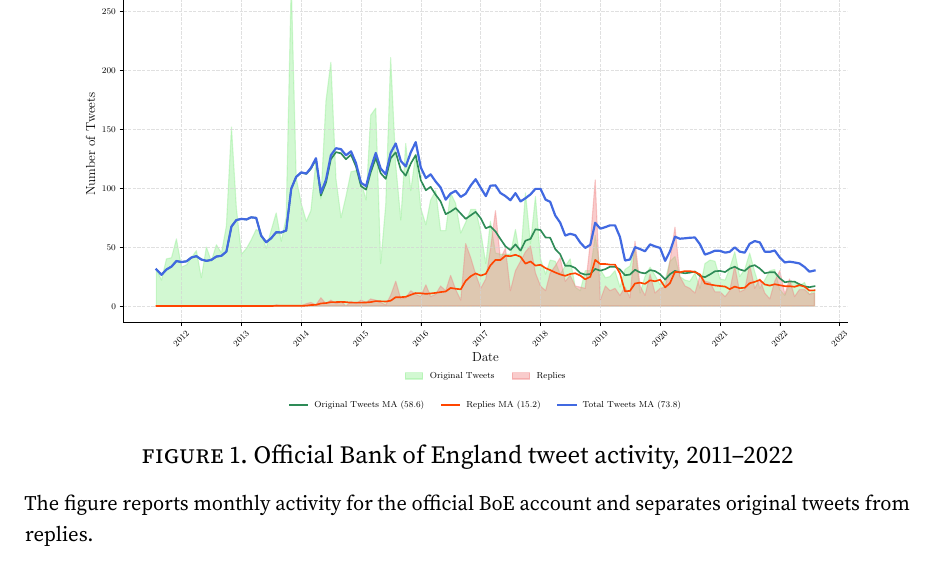
The analysis uses 9,810 official Bank of England tweets from July 2011 to July 2022. Engagement is measured as the sum of likes, retweets, replies, and quote tweets. The mean total engagement is 32.55, the median is 10, and the distribution is highly right-skewed.
Method
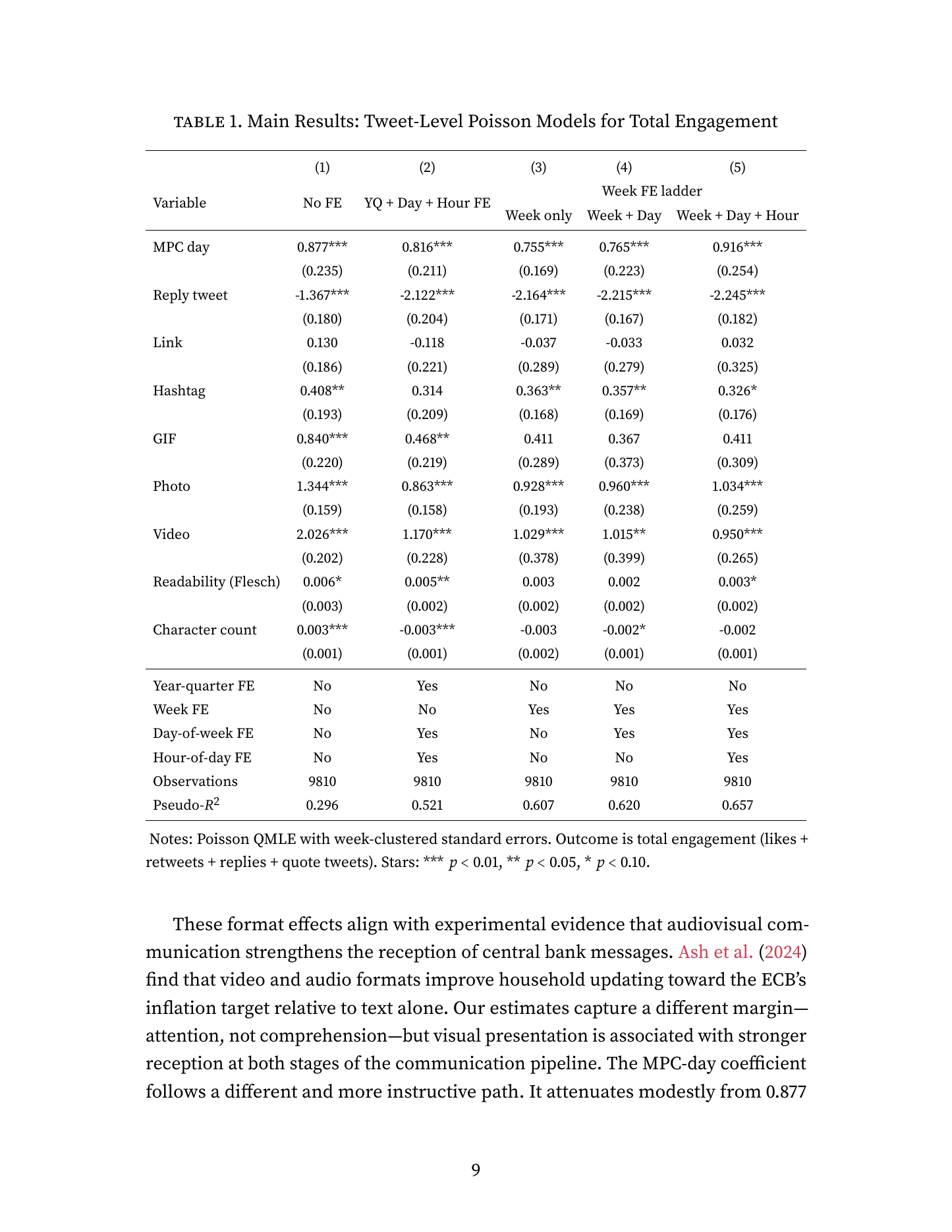
The paper estimates tweet-level Poisson models with progressively tighter time controls, including week fixed effects. It studies format indicators, readability, character count, reply status, and MPC announcement-day timing.
Findings
Visual formats matter
Photo tweets and video tweets receive much higher engagement than otherwise similar tweets.
Policy days matter
MPC announcement-day tweets receive substantially more engagement, especially after the return of high inflation.
Replies have lower reach
Reply tweets attract about 89 per cent less engagement, suggesting a trade-off between conversation and visible reach.
Readability is secondary
Readability is positive in some specifications but weaker than format and timing.
The paper contributes tweet-level evidence on the public-attention margin of central-bank communication. It complements work on comprehension and expectations by studying whether official messages receive visible interaction in the first place.
Figures and tables
| Evidence | Result | Interpretation |
|---|---|---|
| Photo tweets | Roughly 181 per cent more engagement | Visual format is strongly associated with attention. |
| Video tweets | Roughly 159 per cent more engagement | Rich media helps official messages travel. |
| MPC announcement day | Roughly 150 per cent more engagement | Policy salience raises public interaction. |
| Reply tweets | About 89 per cent less engagement | Dialogue and reach can point in different directions. |
Scope and limits
The estimates are associational. Twitter/X users are not representative of the full public, and visible engagement is not the same as comprehension, trust, or expectation formation.
How to cite
APA
Kansoy, F., & Mundy, J. (2025). Central Bank Communication with Public: Bank of England and Twitter (X). University of Oxford Department of Economics Discussion Papers. https://fatih.ai/
Chicago
Kansoy, Fatih, and Joel Mundy. 2025. "Central Bank Communication with Public: Bank of England and Twitter (X)." University of Oxford Department of Economics Discussion Papers. https://fatih.ai/
Harvard
Kansoy, F., & Mundy, J. 2025, 'Central Bank Communication with Public: Bank of England and Twitter (X)', University of Oxford Department of Economics Discussion Papers, available at: https://fatih.ai/
@article{kansoy2025central,
  title   = {Central Bank Communication with Public: Bank of England and Twitter (X)},
  author  = {Fatih Kansoy and Joel Mundy},
  journal = {University of Oxford Department of Economics Discussion Papers},
  year    = {2025},
  url     = {https://fatih.ai/boe_twitter.pdf}
}
Selected references
- Blinder, A. S., Ehrmann, M., Fratzscher, M., De Haan, J., and Jansen, D.-J. 2008. Central bank communication and monetary policy.
- Blinder, A. S., Ehrmann, M., Jansen, D.-J., and de Haan, J. 2024. Central bank communication with the general public.
- Haldane, A. G., Macaulay, A., and McMahon, M. 2020. The 3 E's of central bank communication with the public.
- Coibion, O., Gorodnichenko, Y., and Weber, M. 2022. Monetary policy communications and household inflation expectations.
- Gorodnichenko, Y., Pham, T., and Talavera, O. 2025. Central bank communication on social media.