Research · Mar 25, 2026
Central Bank Communication and CBDC Implementation
Fatih Kansoy · Published in: University of Oxford Department of Economics Discussion Papers
Plain-Language Summary
The paper studies a talk-action gap. CBDC has become a regular topic in central-bank speeches, but many jurisdictions remain at research or exploration stages. The question is whether stronger public commitment in speeches tells us that implementation is coming, or whether it mostly reflects participation in a global policy debate.
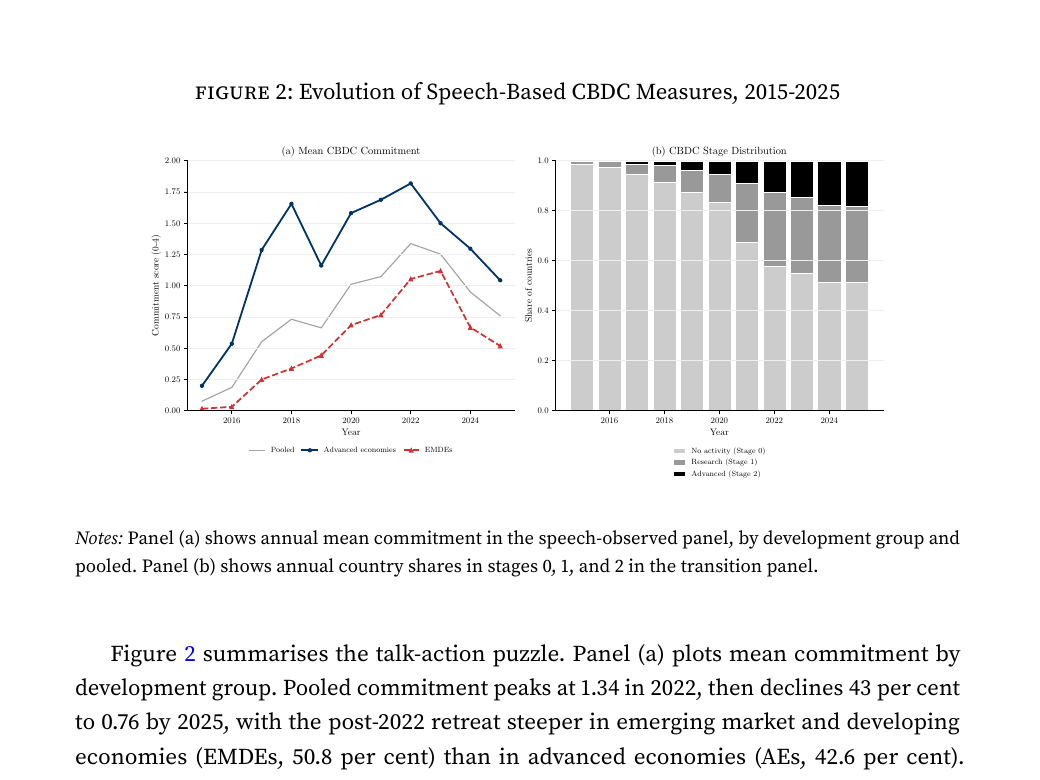
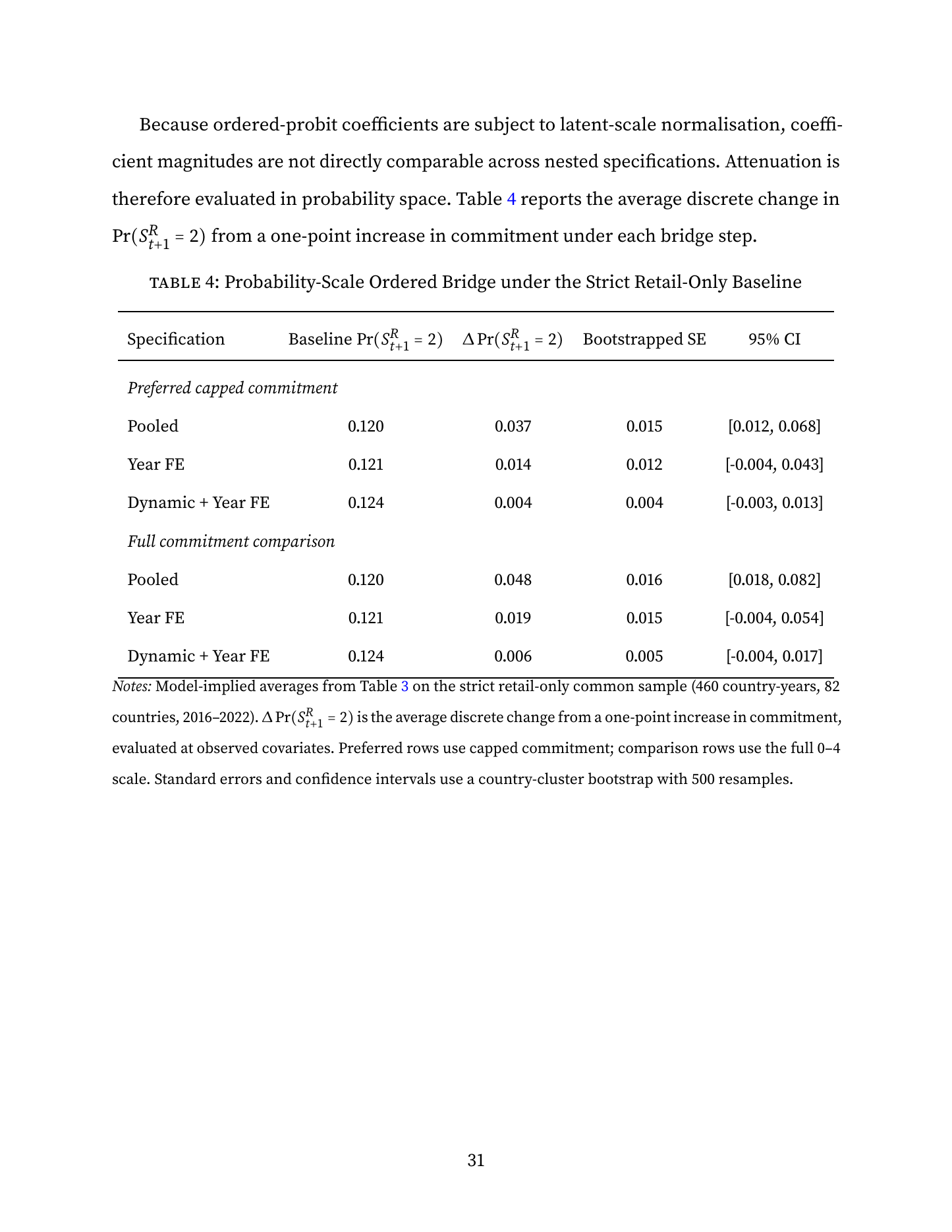
The evidence suggests that public commitment is useful for understanding agenda-setting, but weak for predicting advancement beyond research once previous CBDC stage and common time shocks are controlled. Legal-regulatory language, open-economy vulnerability, and institutional risk tolerance are more informative about progression.
The broader point is institutional. Public deliberation is relatively low-cost: it signals awareness, keeps options open, and responds to peer pressure. Moving beyond research is costly because it exposes central banks to legal authority questions, financial stability concerns, and political risks.
Research Question
Does central-bank communication about CBDC predict implementation, or does it mainly capture low-cost agenda participation?
Why It Matters
CBDC debate is global, but implementation depends on legal authority, financial openness, and institutional risk. The paper helps separate rhetorical convergence from actual policy progression.
Data
The paper uses a country-year panel built from 15,906 scored central-bank speeches from 122 jurisdictions between 2015 and 2025, drawn from a broader corpus of 37,814 speeches from 134 jurisdictions. It links speech measures to retail CBDC stages and country-level institutional variables.
Method
Speech excerpts are scored for CBDC commitment, technology salience, and constraint dimensions under a structured rubric. The empirical design relates those measures to CBDC stage progression with dynamic controls, common time shocks, and institutional covariates.
Contribution and Findings
Commitment tracks talk
Public commitment captures whether CBDC is on the policy agenda, but adds little stable information about advancement beyond research once prior stage is controlled.
Open capital accounts slow progression
Capital account openness is negatively associated with movement beyond research, consistent with open-economy risk exposure.
Legal constraints are informative
Legal-regulatory concern language is the most stable negative speech correlate of advancement.
Prediction gains are small
Adding speech measures to strong baseline predictors only modestly changes predictive performance; intervals include zero.
The paper contributes a speech-based CBDC panel and shows that the correlates of public deliberation differ from the correlates of implementation. It links CBDC communication to institutional isomorphism and policy-practice decoupling.
Figures and Tables
Results Table
Key results from the paper
| Evidence | Result | Interpretation |
|---|---|---|
| Public commitment | Attenuates sharply once prior stage and common shocks enter | Commitment is more agenda signal than implementation predictor. |
| Capital account openness | Negative association with advancement beyond research | Open-economy risk matters for progression. |
| Legal-regulatory language | Consistently negative in sign | Legal feasibility is a revealed constraint. |
| Predictive model | AUC gain from speech measures is small | Speech adds limited stable predictive power beyond structural variables. |
Scope and Limits
The speech measures reveal how central banks frame CBDC, not private internal decisions. Legal-constraint language can be both a cause and a symptom of stalled progress, so it is best interpreted as a revealed feasibility marker.
Selected References
- BIS. 2025. Advancing retail CBDC work while preserving optionality.
- Blinder, A. S., Ehrmann, M., de Haan, J., and Jansen, D.-J. 2024. Central bank communication with the general public.
- Bossu, W., Itatani, M., Margulis, C., Rossi, A., Weenink, H., and Yoshinaga, A. 2020. Legal aspects of central bank digital currency.
- Kosse, A. and Mattei, I. 2023. Making headway: Results of the 2022 BIS survey on central bank digital currencies.
- Gurkaynak, R. S., Sack, B., and Swanson, E. 2005. Do actions speak louder than words?
How to Cite
Use the copy buttons for quick citation text, or open the raw BibTeX and RIS records in your browser.
APA
Kansoy, F. (2026). Central Bank Communication and CBDC Implementation. University of Oxford Department of Economics Discussion Papers. https://fatih.ai/research/central_bank_communication_and_cbdc_implementation/Chicago
Kansoy, Fatih. 2026. "Central Bank Communication and CBDC Implementation." University of Oxford Department of Economics Discussion Papers. https://fatih.ai/research/central_bank_communication_and_cbdc_implementation/.Harvard
Kansoy, F. 2026, 'Central Bank Communication and CBDC Implementation', University of Oxford Department of Economics Discussion Papers, available at: https://fatih.ai/research/central_bank_communication_and_cbdc_implementation/.BibTeX
@article{kansoy2026cbdc,
  title   = {Central Bank Communication and CBDC Implementation},
  author  = {Fatih Kansoy},
  journal = {University of Oxford Department of Economics Discussion Papers},
  year    = {2026},
  url     = {https://fatih.ai/cbdc.pdf}
}
RIS
TY  - JOUR
TI  - Central Bank Communication and CBDC Implementation
AU  - Fatih Kansoy
PY  - 2026
T2  - University of Oxford Department of Economics Discussion Papers
UR  - https://fatih.ai/cbdc.pdf
ER  -