Research · Mar 1, 2026
Central Bank Communication Design and Public Attention
Fatih Kansoy · Available as: Working paper
Plain-Language Summary
The paper asks a design question rather than a wording question. Central banks often focus on making communication clearer, but they also choose when to release different pieces of information. The Bank of England's 2015 Super Thursday reform is a natural case because it bundled the rate decision, minutes, forecast report, and press conference into one day.
The evidence shows a trade-off. A bundled full-release day receives more attention than a standard meeting day, and forecast occasions become more salient when they are co-located with the policy decision. But at the quarterly forecast-round level, removing a separate event also removes a separate opportunity for attention.
This is why the paper emphasises communication architecture. A stronger event can still produce less cumulative engagement if the calendar collapses two attention occasions into one. The result is directly connected to rational inattention: salience and frequency both matter.
Research Question
Does the architecture of central-bank communication events shape public attention, beyond the content of the message itself?
Why It Matters
The paper matters for how central banks design communication calendars. Transparency is not only about releasing more information; it is also about sequencing information so that public attention is not accidentally compressed.
Data
The paper uses Bank of England MPC event calendars and three revealed-attention measures: Twitter (X) policy-relevant users, Google Trends search attention, and Wikipedia page views. It compares pre-reform forecast rounds with post-reform full-release days.
Method
The empirical design compares event-level and quarterly forecast-round attention before and after the reform. It uses day-of-week-matched baselines, within-post full-release versus standard meeting comparisons, sensitivity checks, and multiple-testing correction.
Contribution and Findings
Bundled days are salient
Full-release days attract more attention than standard post-reform MPC meetings.
Forecast co-location raises attention
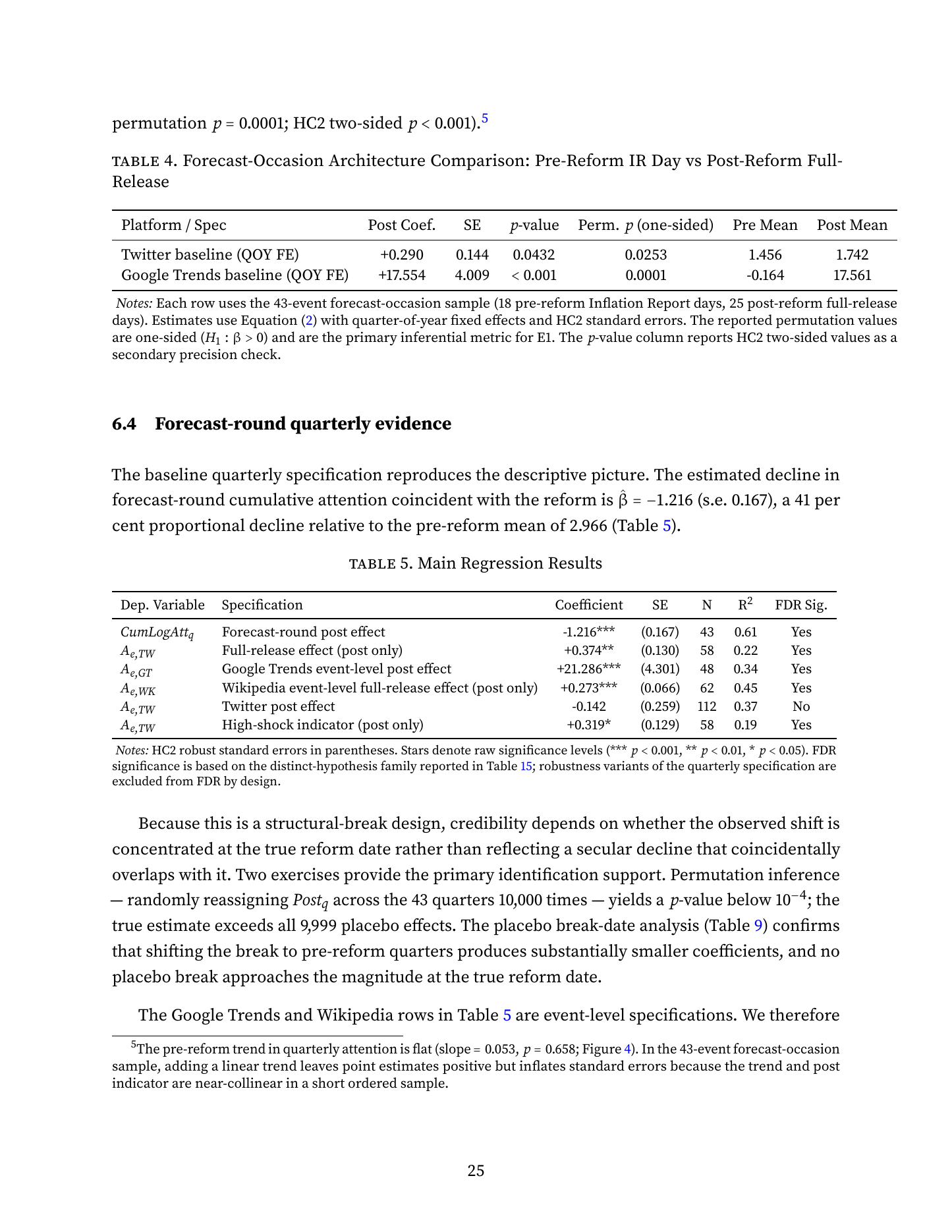
Forecast occasions receive more attention after they are co-located with the rate decision on both Twitter and Google Trends.
Cumulative Twitter engagement falls
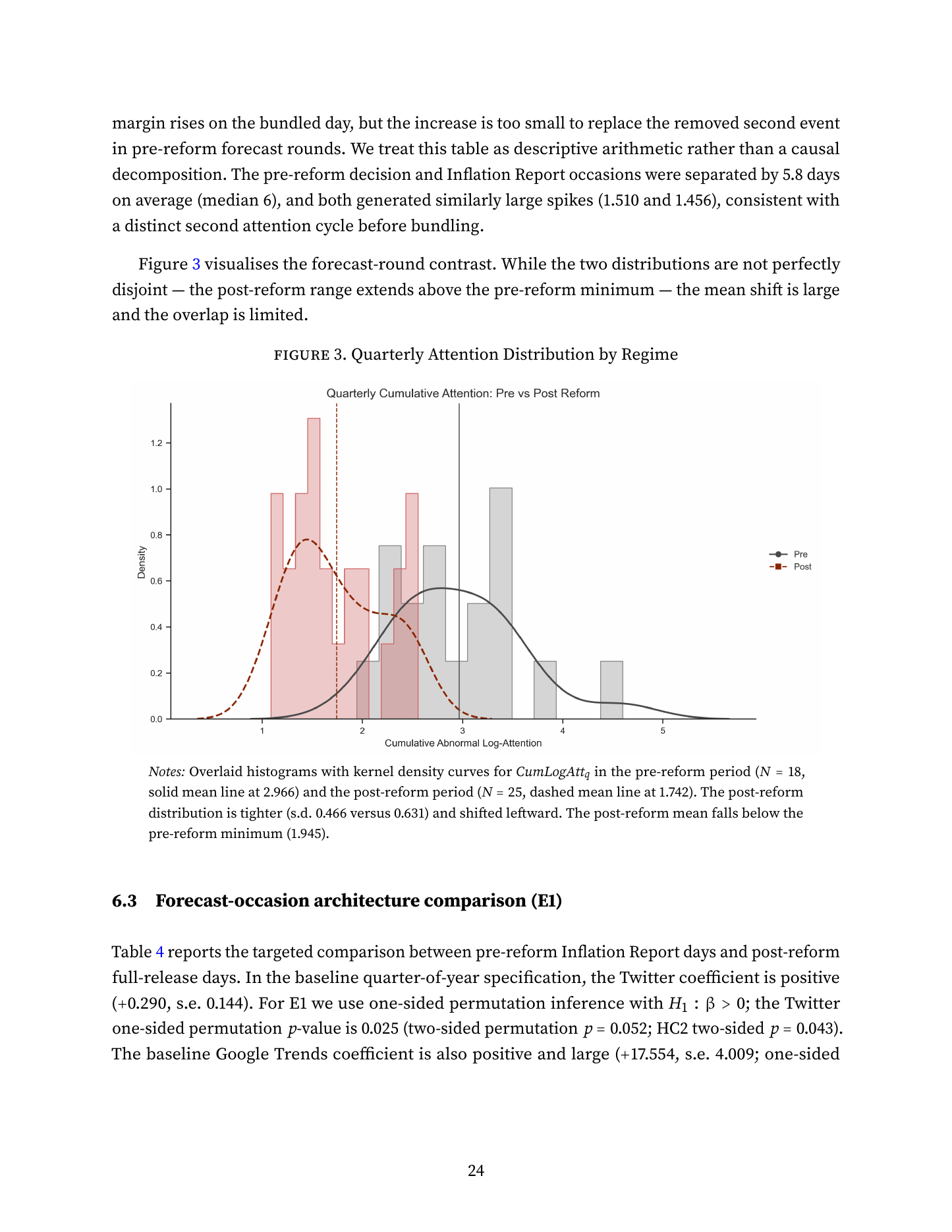
At the quarterly forecast-round level, Twitter engagement is lower after the reform because one separate attention occasion is removed.
Content mix changes
Bundling changes what users attend to, increasing the share of outlook-related discussion on full-release days.
The paper adds communication architecture to the central-bank communication literature. It shows that timing and bundling can change public attention even when the content domain is held fixed.
Figures and Tables
Results Table
Key results from the paper
| Evidence | Result | Interpretation |
|---|---|---|
| Forecast-occasion comparison | Co-location premium on Twitter and Google Trends | Bundling raises event-level salience. |
| Within-post comparison | Full-release meetings outperform standard meetings | The bundled event is more attention-grabbing. |
| Quarterly Twitter engagement | About 41 per cent lower after consolidation | A stronger single day does not fully replace the removed second occasion. |
| Discussion composition | More outlook-related discussion on full-release days | Architecture changes what the public discusses, not only how much. |
Scope and Limits
Digital traces measure revealed attention rather than comprehension, trust, or expectation formation. Cross-platform quarterly effects are heterogeneous, so the quarterly cumulative result should be read as channel-specific.
Selected References
- Bank of England. 2014. Bank of England announces measures to bolster transparency and accountability.
- Blinder, A. S., Ehrmann, M., de Haan, J., and Jansen, D.-J. 2024. Central bank communication with the general public.
- Blinder, A. S., Ehrmann, M., Fratzscher, M., De Haan, J., and Jansen, D.-J. 2008. Central bank communication and monetary policy.
- Sims, C. A. 2003. Implications of rational inattention.
- Reis, R. 2006. Inattentive consumers.
How to Cite
Use the copy buttons for quick citation text, or open the raw BibTeX and RIS records in your browser.
APA
Kansoy, F. (2026). Central Bank Communication Design and Public Attention. Working paper. https://fatih.ai/research/central_bank_communication_design_public_attention/Chicago
Kansoy, Fatih. 2026. "Central Bank Communication Design and Public Attention." Working paper. https://fatih.ai/research/central_bank_communication_design_public_attention/.Harvard
Kansoy, F. 2026, 'Central Bank Communication Design and Public Attention', Working paper, available at: https://fatih.ai/research/central_bank_communication_design_public_attention/.BibTeX
@article{kansoy2026design,
  title   = {Central Bank Communication Design and Public Attention},
  author  = {Fatih Kansoy},
  journal = {Working paper},
  year    = {2026},
  url     = {https://fatih.ai/cbc.pdf}
}
RIS
TY  - JOUR
TI  - Central Bank Communication Design and Public Attention
AU  - Fatih Kansoy
PY  - 2026
T2  - Working paper
UR  - https://fatih.ai/cbc.pdf
ER  -