Research · Jan 1, 2013
Islamic Finance and Istanbul as an International Financial Centre
Fatih Kansoy and Hasan Huseyin Karlioglu · Published in: Afro Eurasian Studies, 2(1-2), 126-143
Plain-Language Summary
The paper was written at a time when Turkey was trying to position Istanbul as an international financial centre. It asks whether Islamic finance could be part of that strategy and whether Istanbul had the institutional foundations needed to compete with established Islamic-finance hubs.
The answer is cautious. Istanbul has geographic, historical, and banking-sector advantages, but the paper argues that a financial centre also requires legal credibility, human capital, regulatory coordination, image, specialised courts, and internationally recognisable Islamic-finance infrastructure.
The paper's policy message is that ambition is not enough. Islamic finance can support Istanbul's financial-centre strategy only if the institutional and regulatory environment becomes predictable, internationally credible, and supported by specialised expertise.
Research Question
Can Islamic finance help Istanbul become an international financial centre?
Why It Matters
The paper connects financial-centre strategy to institutional capacity. It treats Islamic finance not only as a banking product but as an ecosystem requiring law, education, regulation, tax policy, and reputation.
Data
The paper uses financial-centre rankings, Islamic-finance city comparisons, policy documents, sector statistics, and institutional evidence on Turkey's banking and legal environment.
Method
The paper is a policy and institutional assessment. It compares Istanbul's advantages and constraints with the requirements of an international Islamic-finance centre and with examples such as Malaysia and other global financial centres.
Contribution and Findings
Potential exists
Istanbul's location, relations with Muslim countries, and banking system give it strategic potential.
Institutional gaps are binding
The paper identifies image, legal infrastructure, human capital, and regulatory coordination as major barriers.
Human capital is central
The paper argues for specialised education and training capacity in Islamic finance.
Legal credibility matters
Specialised courts, stable tax rules, and harmonised regulation are necessary for international credibility.
The paper offers an early institutional assessment of Turkey's Islamic-finance ambitions and links financial-centre policy to concrete legal, educational, and regulatory conditions.
Figures and Tables
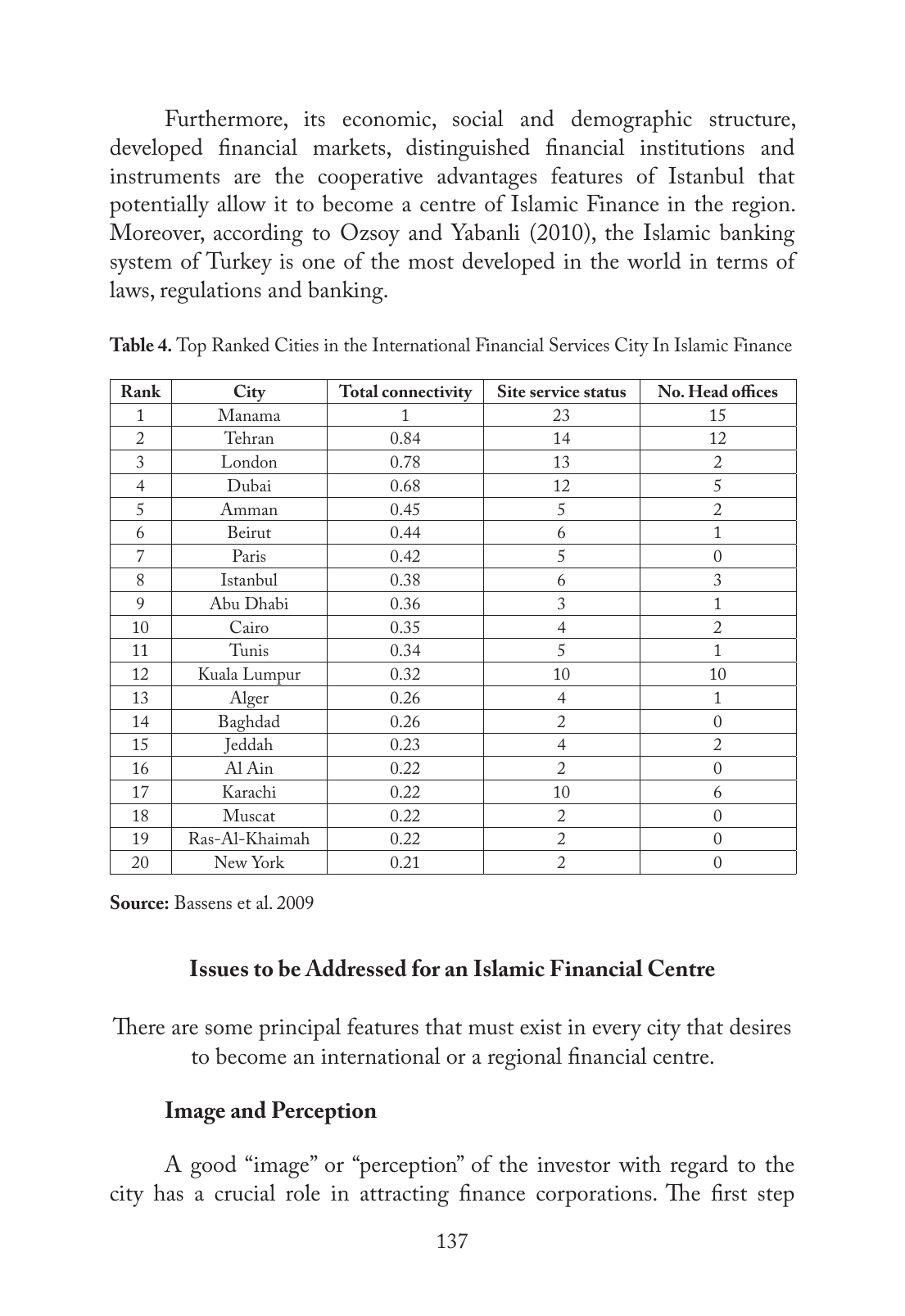
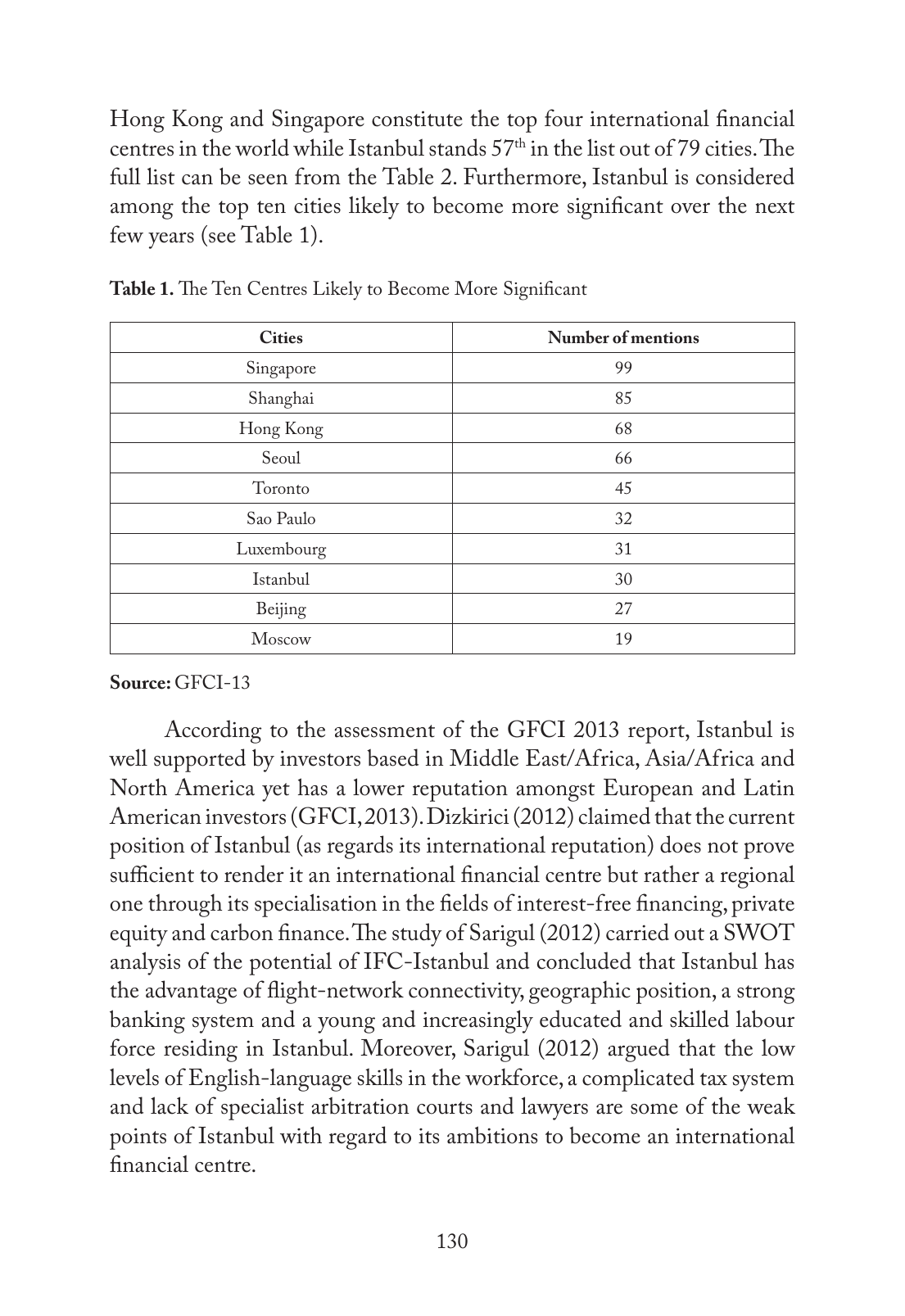
Results Table
Key results from the paper
| Evidence | Result | Interpretation |
|---|---|---|
| Strategic location | Istanbul links Europe, the Middle East, Eurasia, and Africa | Geography supports the financial-centre ambition. |
| Banking system | Turkey has a strong banking base | Conventional banking strength can support Islamic-finance development. |
| Legal and regulatory environment | Insufficiently specialised and coordinated | Institutional reform is necessary. |
| Human capital | Need for specialised Islamic-finance education | A financial centre requires trained professionals and credible standards. |
Scope and Limits
The article reflects the institutional context and data available around 2013. It should be read as a historical and policy assessment rather than a current ranking of Istanbul's financial-centre position.
Selected References
- Bassens, D., Derudder, B., and Witlox, F. 2010. Searching for the Mecca of finance.
- Cevik, S. and Charap, J. 2011. The behavior of conventional and Islamic bank deposit returns.
- State Planning Organisation of Turkey. 2009. Strategy and action plan for Istanbul International Financial Center.
- Z/Yen Group. 2013. The Global Financial Centres Index 13.
- Financial Times reports on Istanbul and Islamic finance cited in the article.
How to Cite
Use the copy buttons for quick citation text, or open the raw BibTeX and RIS records in your browser.
APA
Kansoy, F., & Karlioglu, H. H. (2013). Islamic Finance as a Means to Make Istanbul an International Financial Centre. Afro Eurasian Studies, 2(1-2), 126-143. https://fatih.ai/research/islamic_finance_istanbul/Chicago
Kansoy, Fatih, and Hasan Huseyin Karlioglu. 2013. "Islamic Finance as a Means to Make Istanbul an International Financial Centre." Afro Eurasian Studies, 2(1-2), 126-143. https://fatih.ai/research/islamic_finance_istanbul/.Harvard
Kansoy, F., & Karlioglu, H. H. 2013, 'Islamic Finance as a Means to Make Istanbul an International Financial Centre', Afro Eurasian Studies, 2(1-2), 126-143, available at: https://fatih.ai/research/islamic_finance_istanbul/.BibTeX
@article{kansoy2013islamic,
  title   = {Islamic Finance as a Means to Make Istanbul an International Financial Centre},
  author  = {Fatih Kansoy and Hasan Huseyin Karlioglu},
  journal = {Afro Eurasian Studies, 2(1-2), 126-143},
  year    = {2013},
  volume  = {2},
  number  = {1-2},
  pages   = {126-143},
  url     = {https://fatih.ai/islamic_finance_istanbul.pdf}
}
RIS
TY  - JOUR
TI  - Islamic Finance as a Means to Make Istanbul an International Financial Centre
AU  - Fatih Kansoy
AU  - Hasan Huseyin Karlioglu
PY  - 2013
T2  - Afro Eurasian Studies, 2(1-2), 126-143
VL  - 2
IS  - 1-2
SP  - 126
EP  - 143
UR  - https://fatih.ai/islamic_finance_istanbul.pdf
ER  -