
Most corporations adopt artificial intelligence inside daily workflows tied to personal records rather than as commercial software for outside sale. This paper asks whether twelve-month statutory data-breach notifications track internal AI operation differently from commercial AI supply across US public industries.
Across 28,266 cue-bearing SEC Form 10-K filings from 4,451 firms between 2008 and 2025, three separate language-model families and a blinded two-coder human validation audit distinguish internal AI operation from commercial AI supply and link both roles to Privacy Rights Clearinghouse breach records and archived regulatory breach letters.
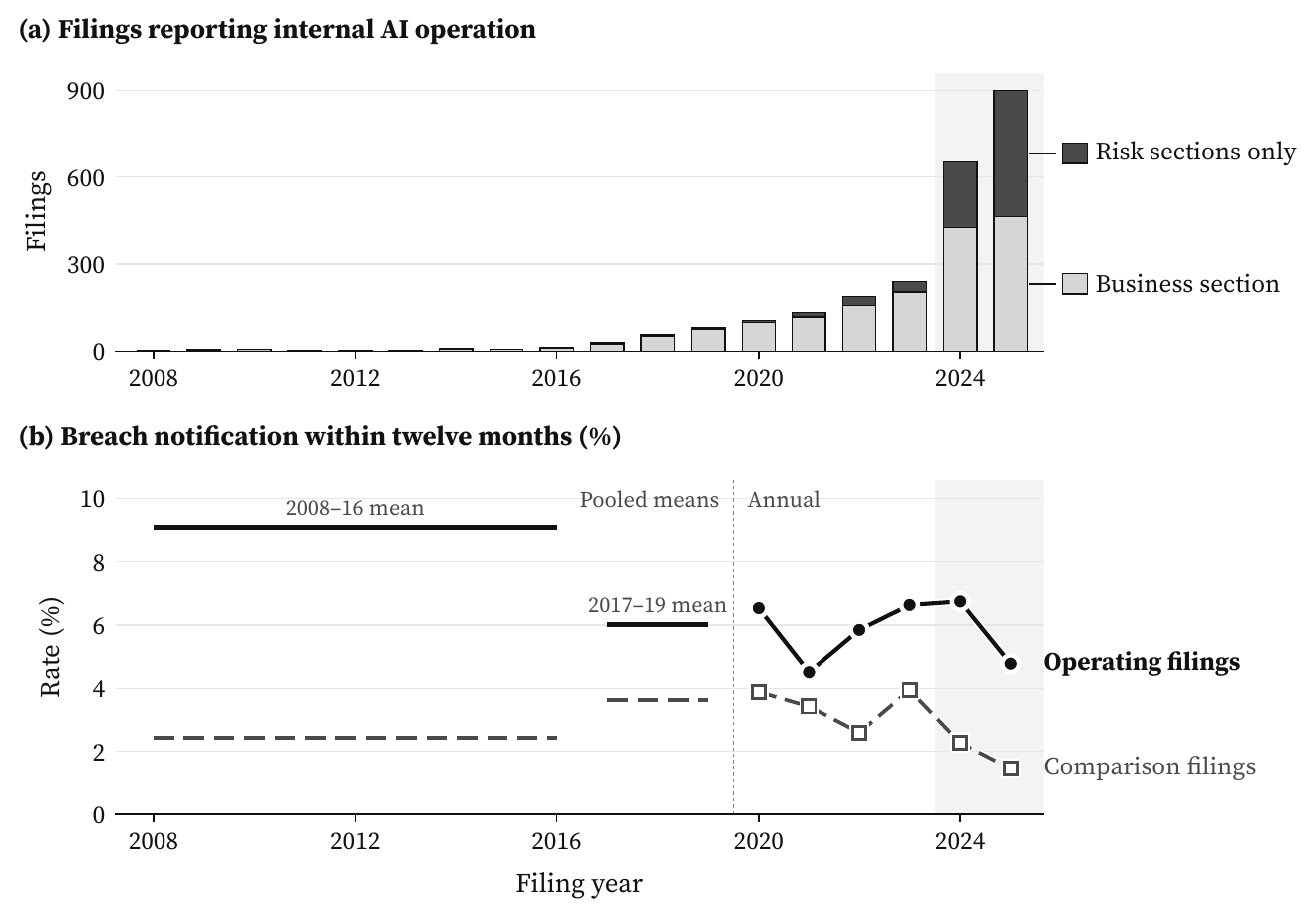
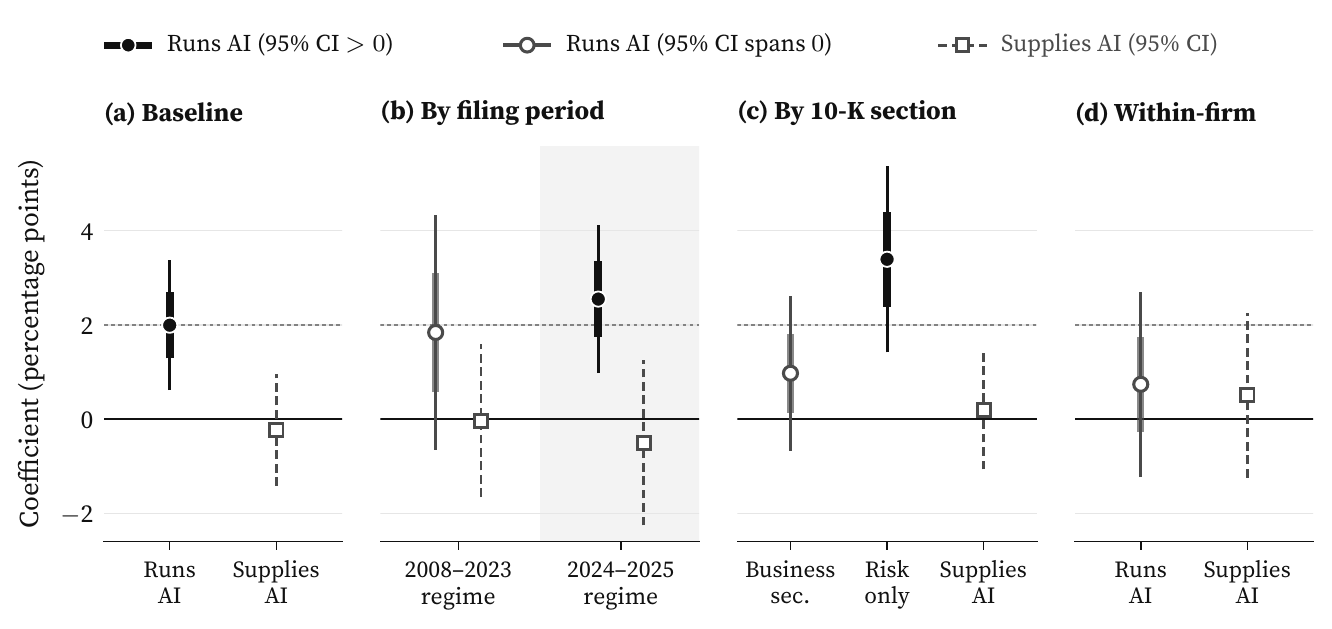
Inside shared three-digit industry-by-year peer groups, internal AI operators experience substantially higher twelve-month statutory breach notification rates (+1.99 percentage points pooled and +2.55 percentage points in 2024–2025) across post-filing breach onsets, two-phase human calibration, and confirmed own-system compromises in primary regulatory letters. Commercial AI supply and a third-party vendor placebo sit near zero.
Internal AI operation associates with a +1.99 percentage-point rise in twelve-month statutory breach notifications (roughly two-thirds of the 3.07 per cent sample mean), reaching +2.55 percentage points in 2024–2025 alongside a +3.05-point role contrast over near-zero commercial AI supply.
Research question
Do public corporations that operate artificial intelligence inside internal business workflows experience higher subsequent statutory data-breach notification rates than same-industry peers, and does any excess risk attach to internal AI operation rather than commercial AI supply?
Why it matters
Empirical studies of corporate AI have focused on patents, workforce skills, and productivity gains without separating firms that wire AI into customer and employee records from firms that build and sell outbound AI software. Because operational exposure concentrates in internal workflows and confirmed own-system compromises, corporate boards, cyber insurers, and financial supervisors should scrutinise live internal AI data connectors, access permissions, and monitoring rather than commercial AI credentials.
Data and method
Data
We assemble 100,274 SEC Form 10-K filings (1994–2026), screen 55,705 cue-bearing reports using three independent language-model families, and validate classifications with a blinded 13-stratum two-coder human audit (349 evaluation filings; design-weighted strict kappa 0.9319). The 28,266-filing main sample (4,451 firms, 2008–2025) links disclosures to 867 statutory twelve-month breach windows from Privacy Rights Clearinghouse and a full primary-letter audit of all 162 notified 2024–2025 windows.
Method
Baseline linear-probability and exponential QMLE regressions compare internal AI operators and commercial AI suppliers inside 3,357 three-digit SIC-by-year cells controlling for log total assets, filing text lengths, cybersecurity and data wording, and prior-year breaches. We pair period interactions, split-section Item 1 versus Item 1A/1C placement regressions, blinded masked passage reading, post-filing onset and lag falsifications, archived primary-letter attribution, and two-phase regression calibration and one-step orthogonal score correction.
Findings
Internal operation drives the breach gap
Internal AI operation associates with a +1.99 percentage-point rise in twelve-month statutory breach notifications (roughly two-thirds of the 3.07 per cent sample mean), reaching +2.55 percentage points in 2024–2025 alongside a +3.05-point role contrast over near-zero commercial AI supply.
Own-system compromises dominate primary letters
Auditing all 162 notified 2024–2025 windows against archived state and federal breach letters verifies issuer identity in 96.9 per cent of cases and assigns 79.5 per cent of the verified operating slope (+1.85 percentage points) to 82 confirmed own-system compromises against an imprecise -0.11 points across 26 pure third-party vendor notices.
Timing, lag, and human-calibration checks hold
Positive operational slopes persist after removing pre-filing breach onsets (+1.04 points pooled and +1.26 points in 2024–2025) without shorter onset-to-notification lags, after dropping defensive cyber-AI users, and under two-phase human regression calibration (+2.04 points pooled and +2.76 points recent).
Risk-factor placement bounds causal claims
Excess notifications concentrate in active present-tense Item 1A risk-factor disclosures (+3.59 points in pure Item 1A filings), where masked reading confirms current deployment in 86.2 per cent of passages. Archival filings therefore leave workflow vulnerability only partly separated from threat-informed disclosure, keeping every estimate strictly conditional.
The paper separates internal AI operation from commercial AI supply across every US public industry and links both roles to statutory breach registries, archived regulatory breach letters, and a blinded two-coder human audit. It shows that corporate cyber exposure tracks internal AI deployment rather than commercial AI product development, while documenting how outcome-correlated text-classification error and Item 105 disclosure selection bound archival inference.
Figures and tables
| Specification | Internal AI operation | Interpretation |
|---|---|---|
| Pooled baseline (2008–2025, SIC3 × year FE) | +1.99 pp (SE 0.70) | Two-thirds of the 3.07% sample mean; commercial supply is -0.23 pp. |
| Recent era (2024–2025) | +2.55 pp (SE 0.80) | +3.05 pp role contrast over commercial AI supply. |
| Primary-letter audit (2024–2025 own-system vs. vendor) | +1.85 pp vs. -0.11 pp | 79.5% of the verified operating gap sits in confirmed own-system breaches. |
| Strict post-filing breach onsets (> filing date) | +1.04 pp pooled / +1.26 pp recent | Persists without shorter onset-to-report lags (median 69 vs. 50 days). |
| Two-phase human regression calibration (N = 349 audit) | +2.04 pp pooled / +2.76 pp recent | Strict slopes hold; one-step score intervals widen sharply in 2024–2025. |
| Within-firm FE (firm + SIC3 × year FE) | +1.43 pp (SE 1.02; MDE 2.86 pp) | Underpowered across 820 switchers; estimates remain conditional. |
Scope and limits
All reported slopes remain conditional associations rather than causal effects. Four boundaries govern interpretation: archival Item 105 filings cannot fully separate created workflow vulnerability from threat-informed risk drafting; unmeasured personal-record stocks remain an open cross-firm confounder behind an underpowered 2.86-point within-firm threshold; calendar concentration in 2024–2025 leaves 4.74 effective year clusters; and recent error-corrected precision relies on regression calibration's conditional surrogacy assumption.
How to cite
APA
Kansoy, F., & Huo, Y. (2026). The Cyber Risk of Operating AI: Evidence from Corporate Data Breaches. University of Oxford Working Paper. https://fatih.ai/
Chicago
Kansoy, Fatih, and Yuhao Huo. 2026. "The Cyber Risk of Operating AI: Evidence from Corporate Data Breaches." University of Oxford Working Paper, November 2026. https://fatih.ai/
Harvard
Kansoy, F., & Huo, Y. 2026, 'The Cyber Risk of Operating AI: Evidence from Corporate Data Breaches', University of Oxford Working Paper, available at: https://fatih.ai/
@unpublished{kansoy2026cyber,
  title  = {The Cyber Risk of Operating AI: Evidence from Corporate Data Breaches},
  author = {Fatih Kansoy and Yuhao Huo},
  note   = {University of Oxford Working Paper},
  month  = nov,
  year   = {2026},
  url    = {https://fatih.ai/cyber_risk_operating_ai.pdf}
}
Selected references
- Amir, E., Levi, S., and Livne, T. 2018. Do firms underreport information on cyber-attacks? Evidence from capital markets. Review of Accounting Studies, 23(3), 1177–1206.
- Babina, T., Fedyk, A., He, A. X., and Hodson, J. 2024. Artificial intelligence, firm growth, and product innovation. Journal of Financial Economics, 151, 103745.
- Campbell, J. L., Chen, H., Dhaliwal, D. S., Lu, H., and Steele, L. B. 2014. The information content of mandatory risk factor disclosures in corporate filings. Review of Accounting Studies, 19(1), 396–455.
- Egami, N., Hinck, M., Stewart, B., and Wei, H. 2023. Using imperfect surrogates for downstream inference: Design-based supervised learning for social science applications of large language models. NeurIPS, 36.
- Florackis, C., Louca, C., Michaely, R., and Weber, M. 2023. Cybersecurity risk. Review of Financial Studies, 36(1), 351–407.
- Kamiya, S., Kang, J.-K., Kim, J., Milidonis, A., and Stulz, R. M. 2021. Risk management, firm reputation, and the impact of successful cyberattacks on target firms. Journal of Financial Economics, 139(3), 719–749.