What the collection holds
The Ottoman state recorded the careers of its officials in the Sicill-i Ahvâl personnel registers. An entry gives an official's birth and family, schooling and languages, appointments and pay, and later additions and corrections. Much of this material now reaches researchers through theses, journal articles and register editions, and each of these usually covers one province, ministry or group of officials.
Ottoman Bureaucracy brings those accounts together in one collective biography. In October 2026 its catalogue held 14,762 biographical records with 288,334 dated career entries, 1,344 named places and 196 scholarly works. Officials from administration, justice, finance, education and other public services appear side by side, and every account keeps its publication and page references, with the archive reference where the work supplies one.
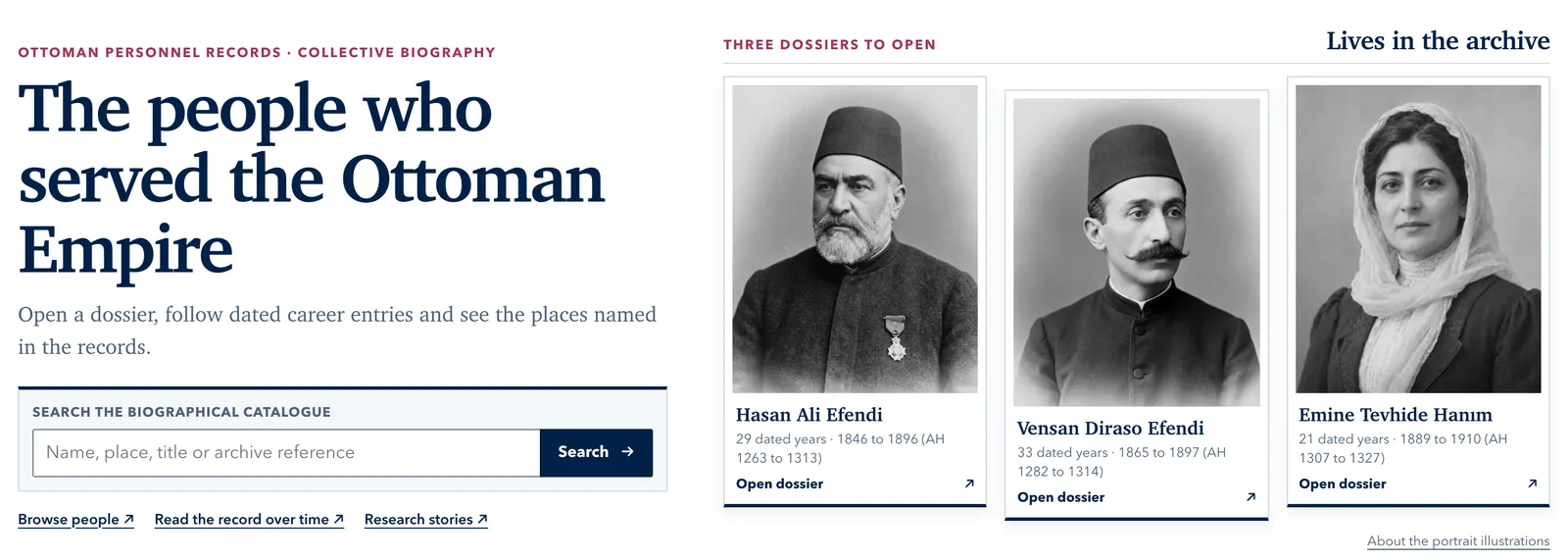
One dossier, many sources
A dossier gathers every source account of one official. Two descriptions of the same appointment count as one appointment, not two. Accounts that might describe the same person stay apart until the archive reference, family, dates and career show that they do.
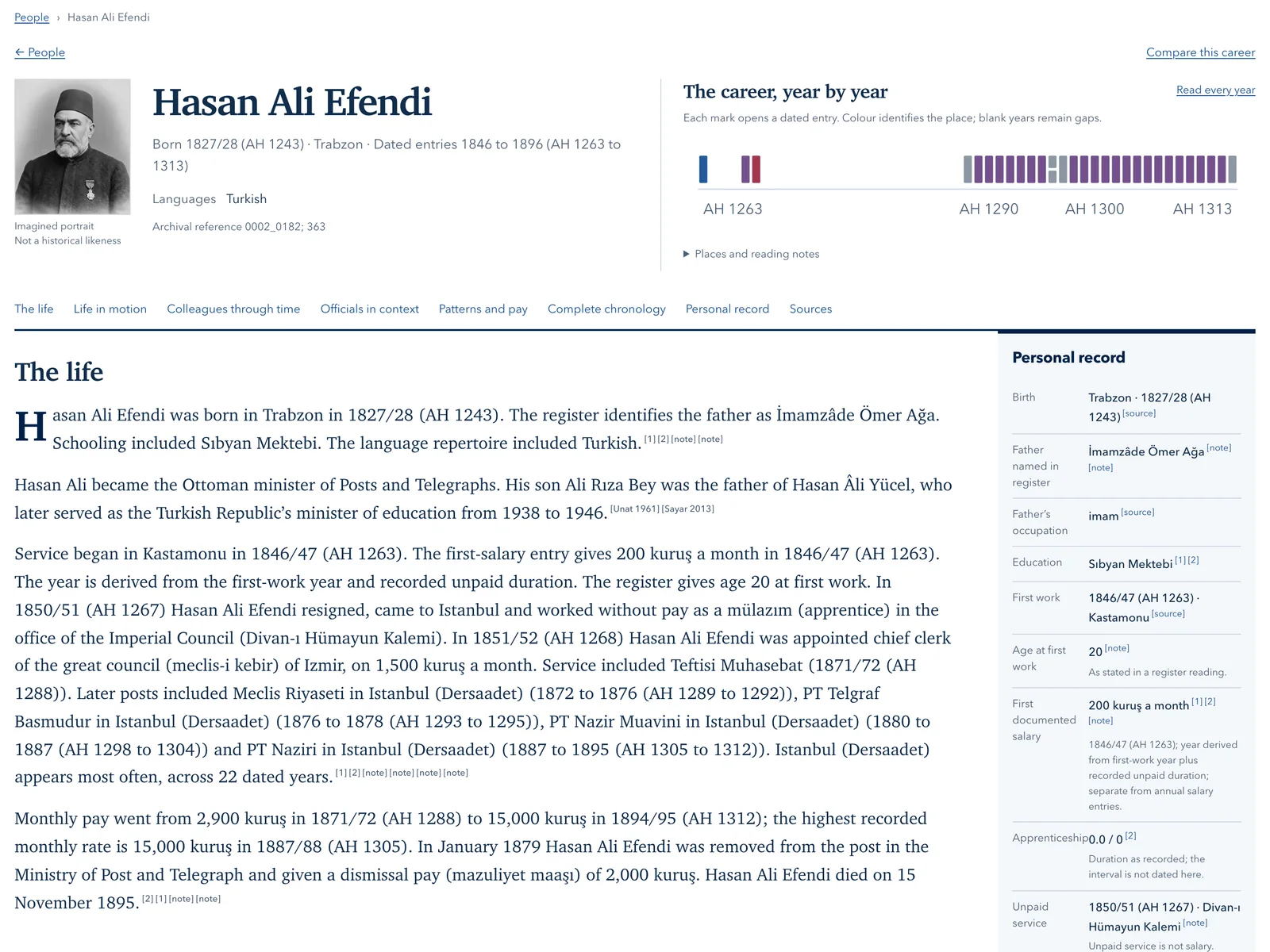
The dossier of Hasan Ali Efendi shows what this gives a reader. Born in Trabzon in 1827/28 (AH 1243), Hasan Ali Efendi began work in Kastamonu in 1846/47 on 200 kuruş a month, worked without pay in Istanbul and then served in İzmir. The career ran through the Post and Telegraph service to the post of its minister, and the monthly salary reached 15,000 kuruş in 1887/88. The record ends with a death on 15 November 1895. Each of these lines carries a note to the source that states it.
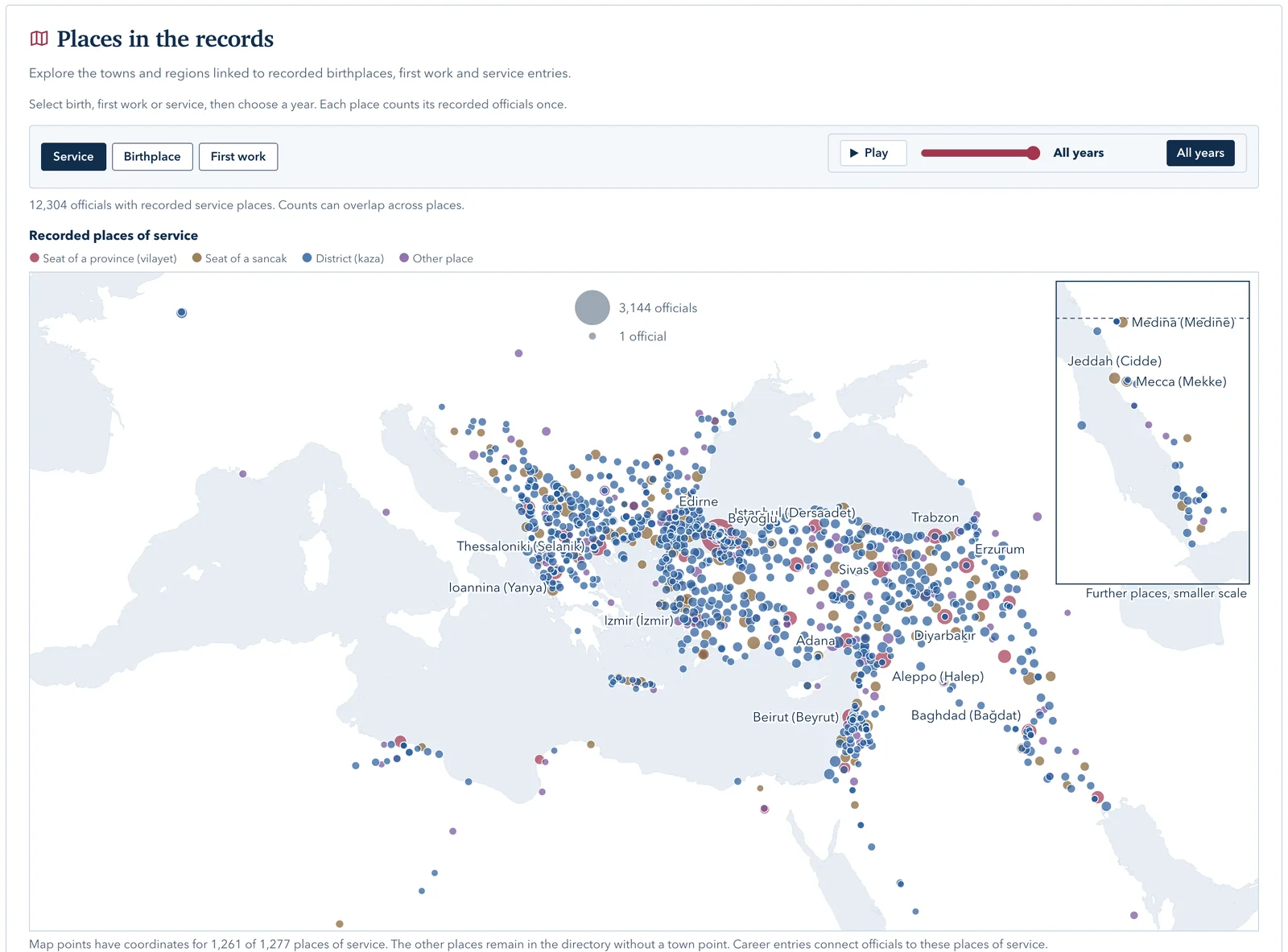
Careers on the map
Birthplaces, first workplaces and later posts share one gazetteer, so a town keeps the same coordinates in every role. The map on the home page shows the places of service and can play through the years. In October 2026 it located 1,261 of the 1,277 places of service. Istanbul appeared in the records of 3,144 officials, more than any other place.
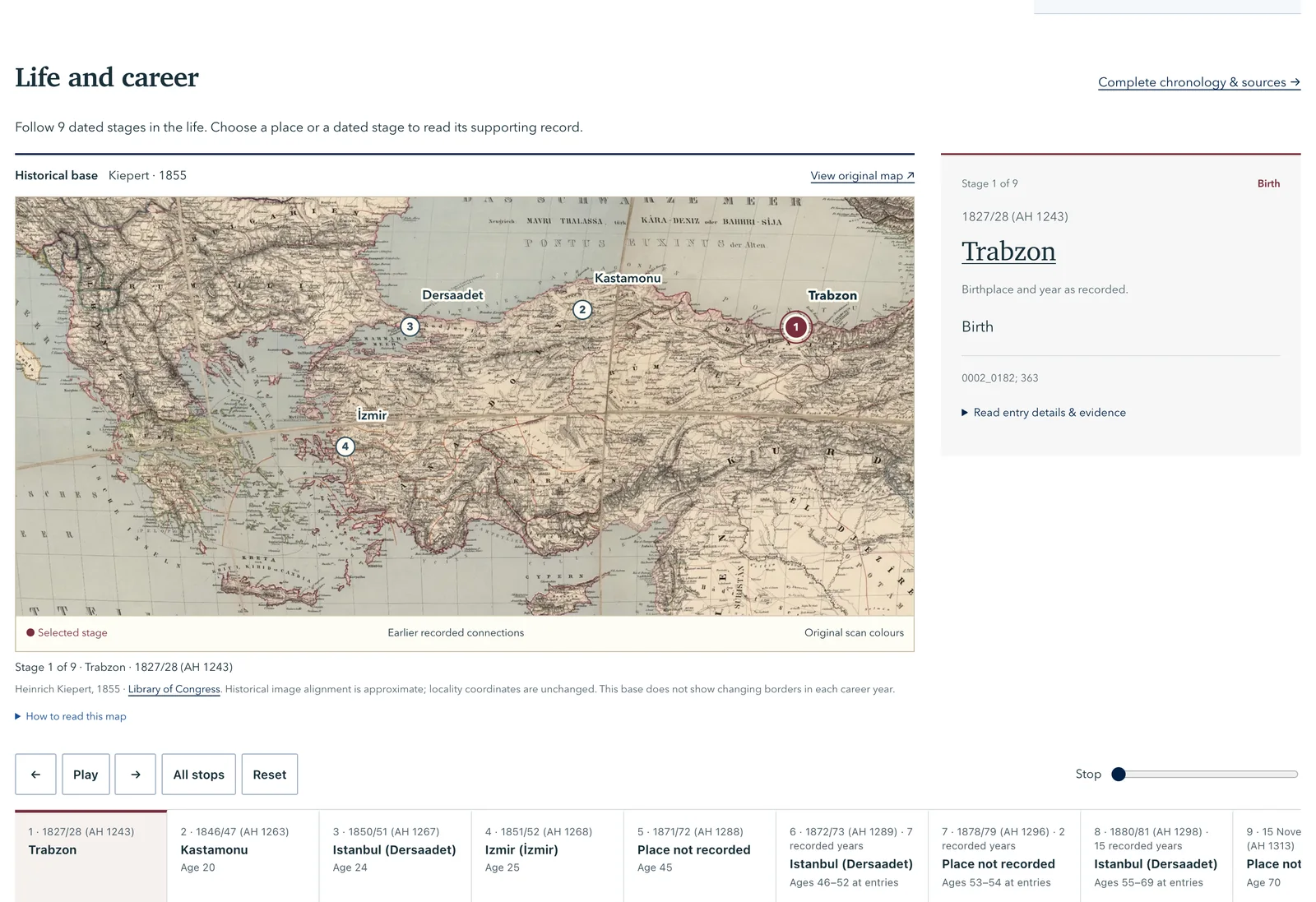
Each dossier also follows a career stage by stage on Heinrich Kiepert's map of 1855 from the Library of Congress. A reader can step through the stages or press play, and each stage opens the evidence behind it.
How to read the records
The site follows a few reading rules on every page. A Hijri year appears with its approximate Gregorian span, such as 1846/47 (AH 1263), and a converted year never claims an exact day. A salary keeps the unit and context of its source, and a monthly salary is never mixed with a pension, an allowance or arrears. A blank means that the source gives no usable value. It does not mean zero, and it does not mean that an official lacked a qualification or a language. When two sources disagree, each value stays attached to its own source.
A first study from the collection
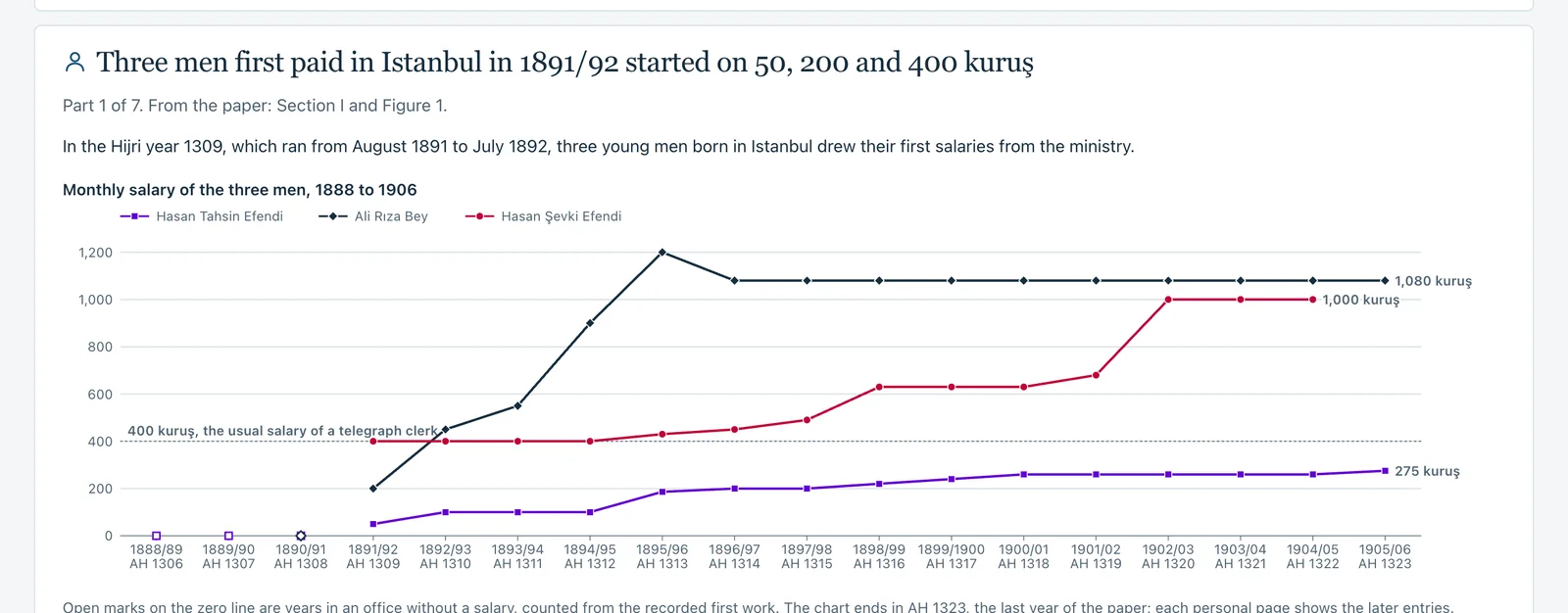
The collection supports research as well as reading. The school and the office follows 4,274 officials of the Post and Telegraph ministry from 1870 to 1905 in 56,395 yearly observations. Most of them first worked for years without a salary, an unpaid service called the mülazemet. In Istanbul, half of the officials with lower schooling who were first paid in 1890 to 1894 waited thirteen years to reach 400 kuruş a month. From 1889/90 the graduates of Darüşşafaka, a charity boarding school for Muslim orphans, started straight on a fixed 400 kuruş.
Access and use
The website is for reading, searching and examining individual records. It is not an open-data service, and bulk downloading or automated collection needs written permission. A validated research dataset with documentation is planned for public release once corpus construction, source verification, quality checks and rights review are complete.
The project is led by Fatih Kansoy and Ömer Akyıldız with research funding from the University of Oxford, and the site is dedicated to the historian Carter V. Findley. The software sicilahval grew out of the workflows used to review these biographies.